What makes IMs effective?
Effective materials do many of the things a teacher would normally do as part of his or her teaching. These include:
- Arouse the learners’ interest.
- Tell them what they will be learning next.
- Explain new learning content to them.
- Set clear learning targets.
- Provide them with strategies to use in learning.
- Provide opportunities for meaningful practice.
source: https://www.professorjackrichards.com/effective-teaching-materials/
What challenges and difficulties have you had in constructing an IMs?
A well constructed IMs takes a lot of effort, time, and resources. In this line, the problem associated in constructing an IMs are the lack of availability of the materials, the cost and production, and the alignment of instructional materials to the objective of the lessons.
How should these be constructed and what are the standards?
Criteria. In selecting instructional materials, the following criteria should be considered:
a. Instructional materials should support the educational philosophy, goals and objectives of the District and the objectives of the curricular offering in which the materials will be used.
b. Instructional materials should be appropriate for the age, emotional and social development, and ability level of the students for whom the materials are selected.
c. Instructional materials should be diverse with respect to levels of difficulty, reader appeal, and should present a variety of points of view.
d. Instructional materials should meet high standards of quality in factual content and presentation.
e. Instructional materials should have aesthetic, cultural, literary, or social value. The value and impact of any literary work will be judged as a whole, taking into account the author’s intent rather than individual words, phrases or incidents.
f. Instructional materials should foster respect for men, women, the disabled, and minority groups and should portray a variety of roles and life styles open to people in today’s world. Instructional materials should foster respect for cultural diversity.
g. Instructional materials should be designed to motivate students to examine their own attitudes and behaviors and to comprehend their own duties, responsibilities, rights and privileges as participating citizens in a pluralistic society.
h. Instructional materials should encourage students to utilize higher order thinking skills and to become informed decision-makers, to exercise freedom of thought and to make independent judgments through examination and evaluation of relevant information, evidence and differing viewpoints.
i. Instructional materials should be selected taking into account instructional materials already available in the District in order to meet the above criteria and in order to replace materials worn, obsolete or no longer appropriate.
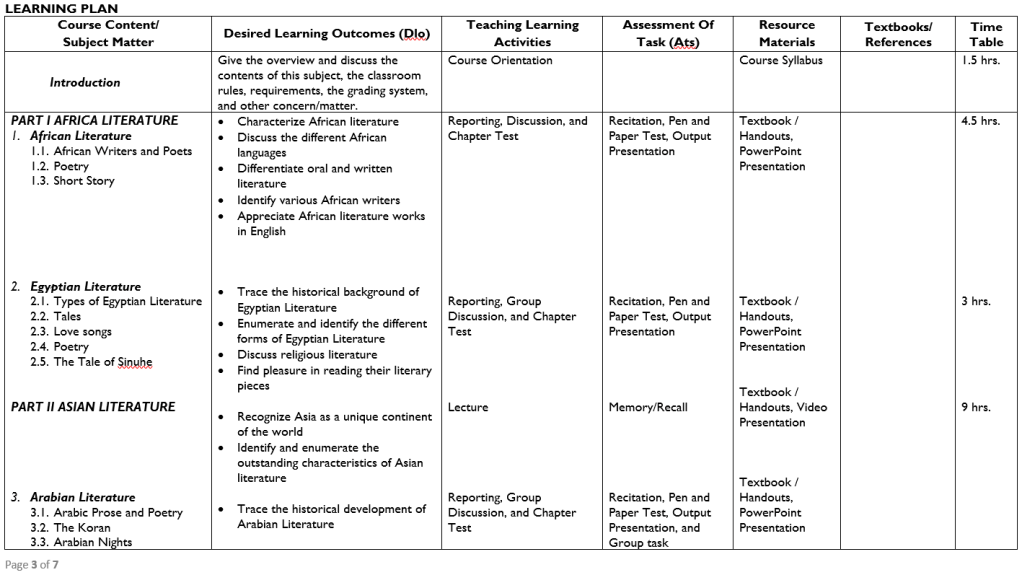
Task 3: IMs
| Course Name | AFRO-ASIAN LITERATURE |
| Course Credits | 3 units |
| Course Description | This course deals with the literatures of Asia and Africa in the different genres. It is the study of patterns of literature of the areas in point of content and form. Likewise, it is the study of wisdom, values and culture in the different areas of Asia and Africa through literature. It is also includes highlights of the lives of anthologize writers. |
| Contact Hours/Week | 3 hours |
| Prerequisite | |
| Course Outcome | Utilized multimedia resources presenting a documentary or broadcast report the development of Asian and African literatures. Analyze literary masterpieces written by Asian and African writers to appreciate literary arts, culture, tradition, human values reflected in the literary pieces. |
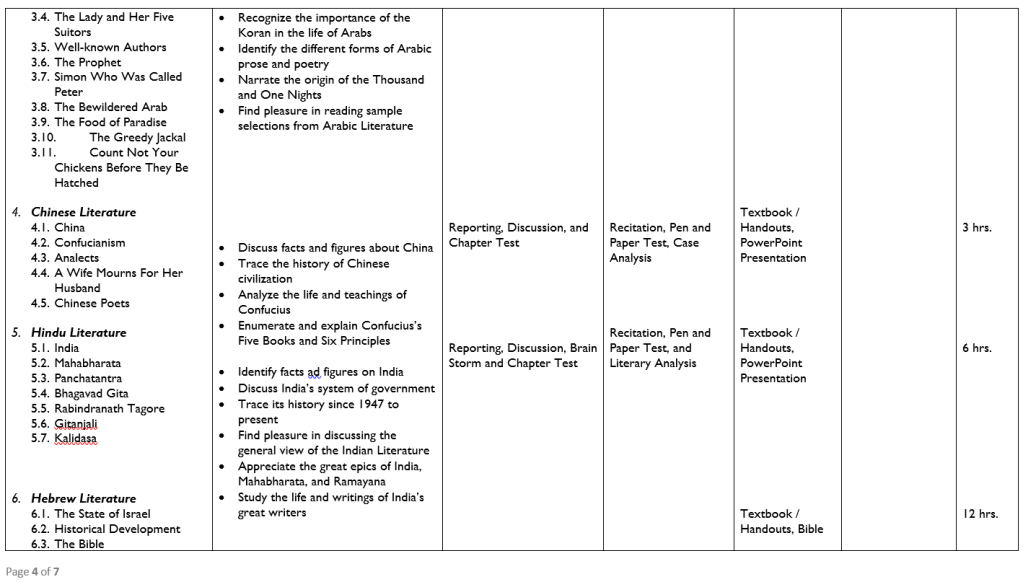
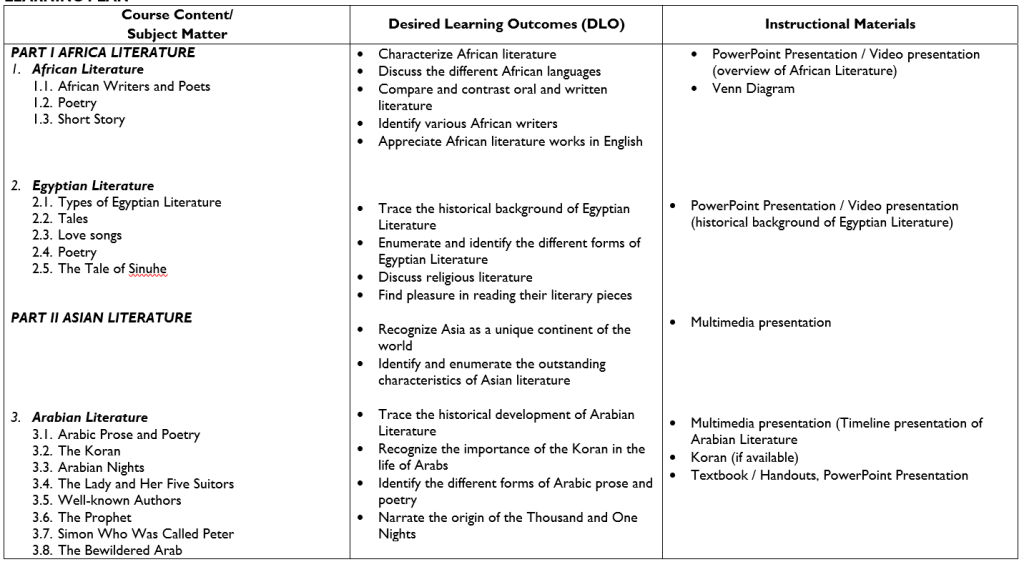
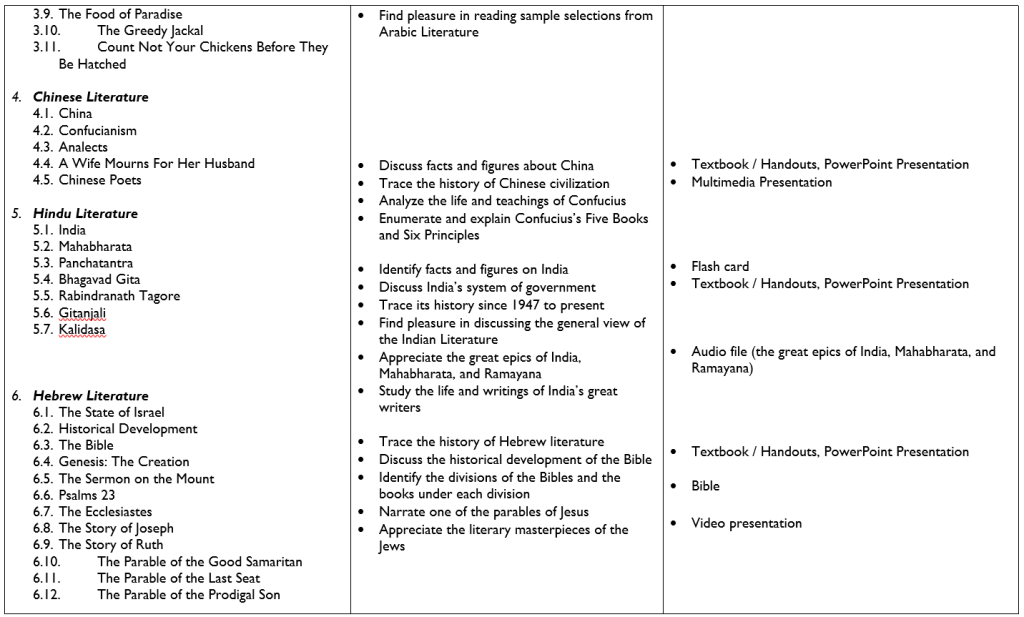
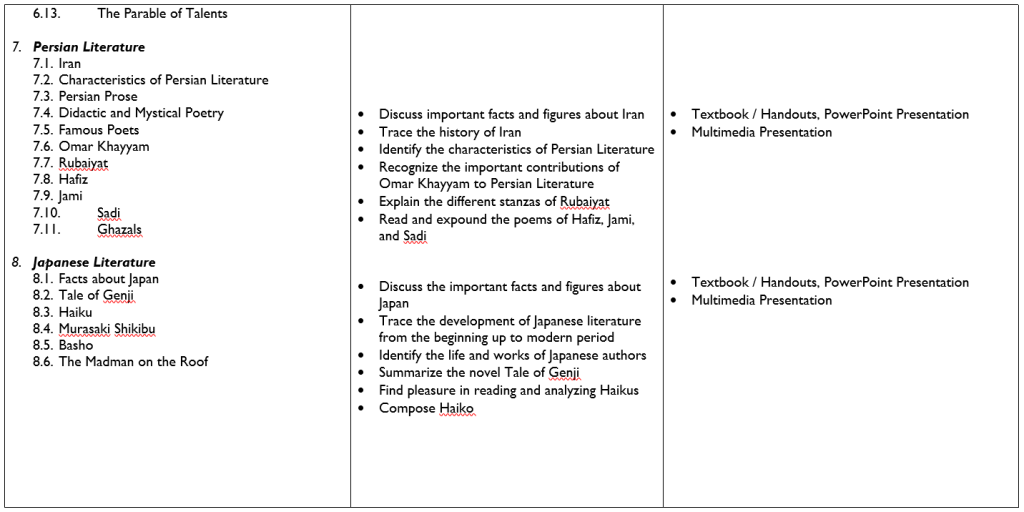
| COURSE OUTLINE AND TIMEFRAME | |
| Course Content/Subject Matter | |
| Week 1 | Introduction |
| Week 2 | PART I – AFRICA |
| Chapter 1 – African Literature | |
| Week 3 | Chapter 2 – Egyptian Literature |
| Week 4 – 6 | PART II – ASIAN |
| Chapter 3 – Arabian Literature | |
| Week 7 | Chapter 4 – Chinese Literature |
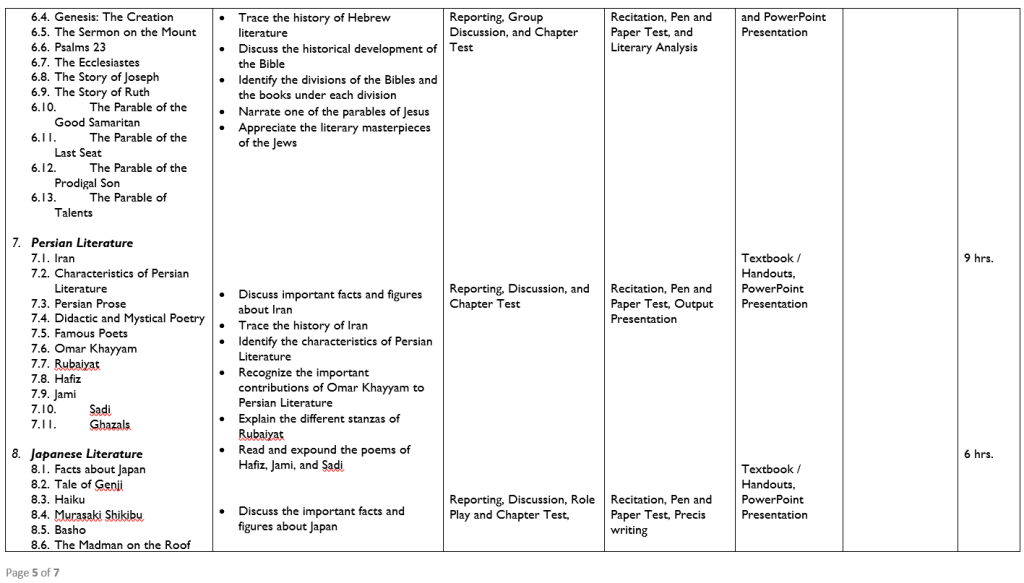
| Week 8 – 9 | Chapter 5 – Hindu Literature |
| Week 10 – 13 | Chapter 6 – Hebrew Literature |
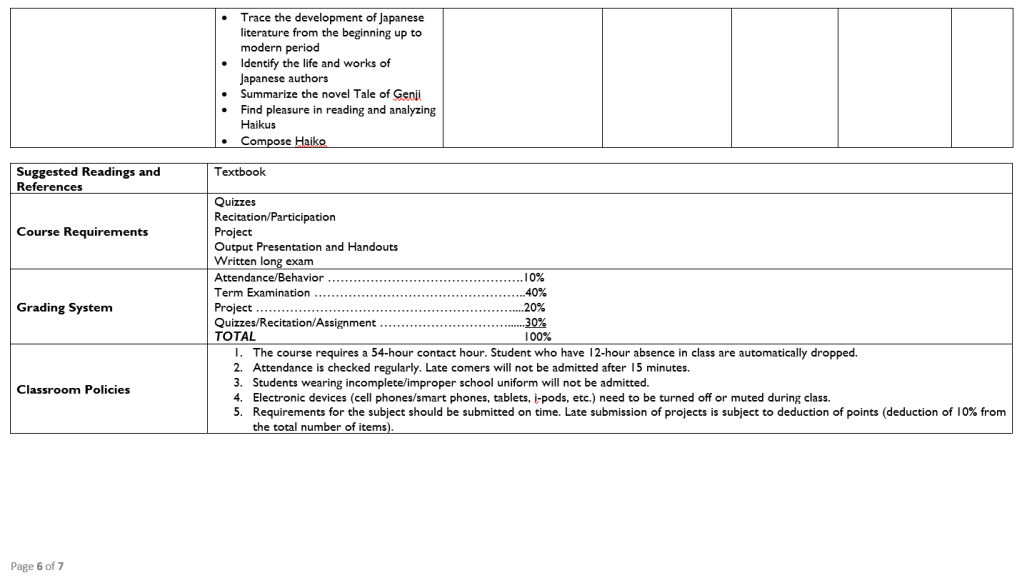
| Week 14 – 16 | Chapter 7 – Persian Literature |
| Week 17 – 18 | Chapter 8 – Japanese Literature |
 My Journal